| |
Math Clocks
& Other Interesting Clocks
Our math clocks have been selected by
 in Pasadena for its campus bookstore in Pasadena for its campus bookstore
 in London for its holiday gift guide in London for its holiday gift guide
 in New York for its museum shop in New York for its museum shop
 at JRMF.org for its online store at JRMF.org for its online store
|
| |
Note: Clicking
on a picture of a clock
opens a new window containing a larger
picture of that clock, so that you can
see it and read about it simultaneously.
|
Purchasing & General
information below
|
| |
 |
The
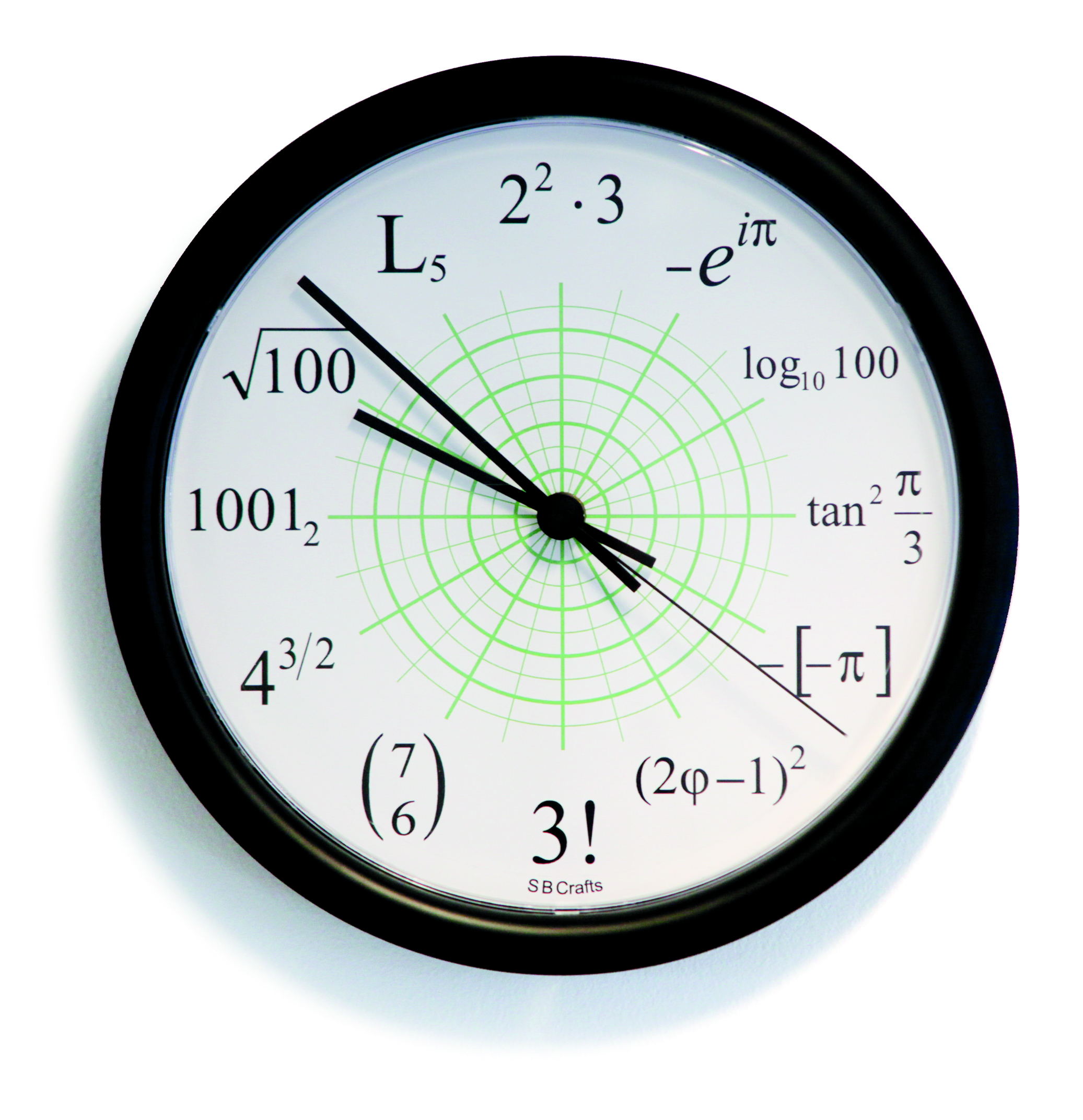
Math Clock – Student Edition & Engineers Edition |
In place of the standard
numbers 1 to 12, this clock displays an interesting assortment of expressions
from many different areas of curriculum and recreational mathematics,
which of course evaluate to the numbers 1 to 12. The student edition
comes with a small green card that provides a couple of conceptual words
for each expression – to facilitate the student looking up the
concepts on the Internet. The engineers edition is labeled as such, so is appropriate for non-students.
|
Particularly well-
suited for engineers and high schoolers. |
| |
|
| |
|
The
Math Clock – Professional Edition |
A more advanced version of
the previous clock, this is our flagship product! The
most advanced expressions involve calculus and number theory. (No hint
card is included but our email address is on the back in case you have
any questions!)
|
For professional
mathematicians,
math aficionados,
or mathematically inclined college students. |
| |
|
| |
|
The Math Clock
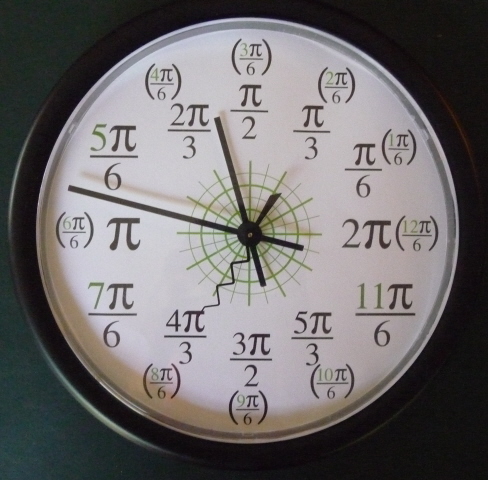
– Radian Edition |
In polar coordinates, angles
are measured counter-clockwise from the positive x-axis. Thus, this clock starts
at midnight with both hands pointing to what is normally the 3 o'clock
position – and then from there it goes backwards!
A full circle is 2π
radians, so each hour is 2π
/12 = π
/ 6 radians. To facilitate time-telling, the unreduced terms' numerators,
which indicate the hours, are written in green.
The squiggly second hand represents a sine wave.
Sorry, this clock is currently unavailable. Email to be notified when it becomes available.
|
Prerequisite - a
course in Algebra
2
or Unit Circle Trigonometry! |
| |
|
| |
|
The Math Clock
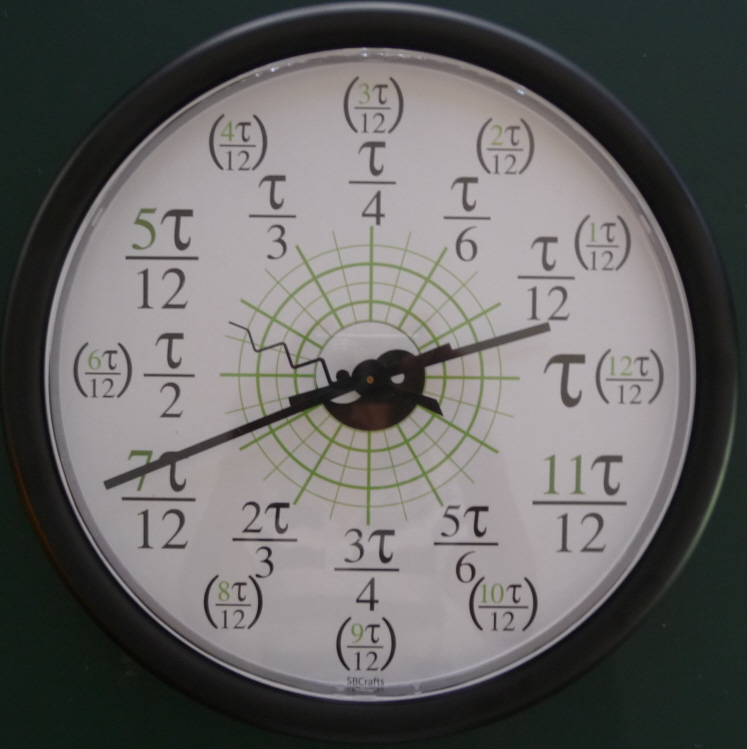
– Radian Edition – Version Tau |
This clock has all the special
features of the previous clock: direction of motion; orientation of
hours; sinusoidal second hand; green cheat marks; and extra time.
However, here the radian measures are expressed in terms of τ,
the true circle constant, rather than .
(See TheTau Manifesto.) A full circle
is τ radians, so each hour is τ /12 radians. The central image includes a Tao symbol. Designed on Tau
Day, 2011.
|
Especially
for
τ aficionados. |
| |
|
| |
|
The Math Clock
– Prime Edition |
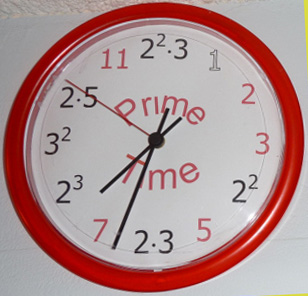
Prime numbers are printed
in red. For composite numbers, their prime
decomposition is shown. Since the number 1 is neither prime nor composite,
which is an important and often-misunderstood fact, it is printed specially,
as an outline. The second hand is red.
|
Recommended for grades 4 to
8, especially for upper elementary or middle school classrooms. |
| |
|
| |
|
The Math Clock
– Primorial Edition |
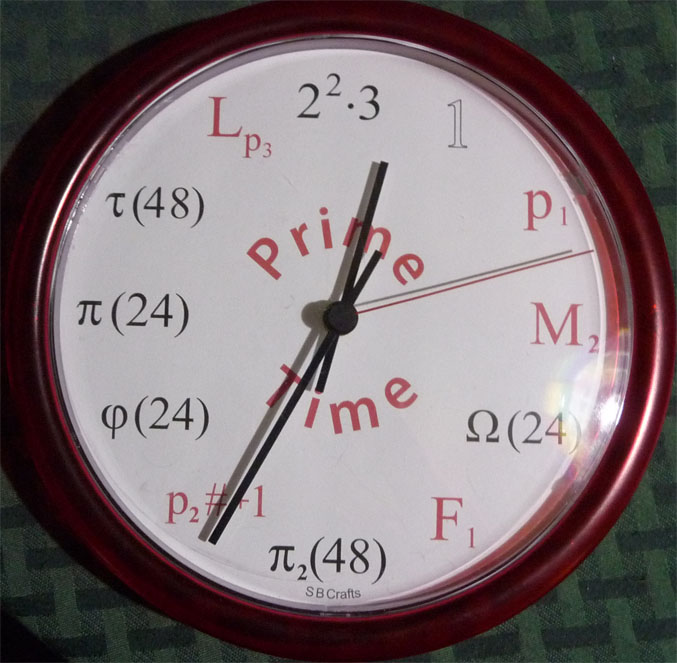
With the same color scheme
as the previous clock, this advanced version uses several different
concepts from prime number theory – prime counting functions, twin primes,
Mersenne primes, Lucas primes, Fermat primes and primorial primes.
|
Recommended for graduate student
or professional number theorists . |
| |
|
| |
|
The Math Clock
–
Perfect Edition |
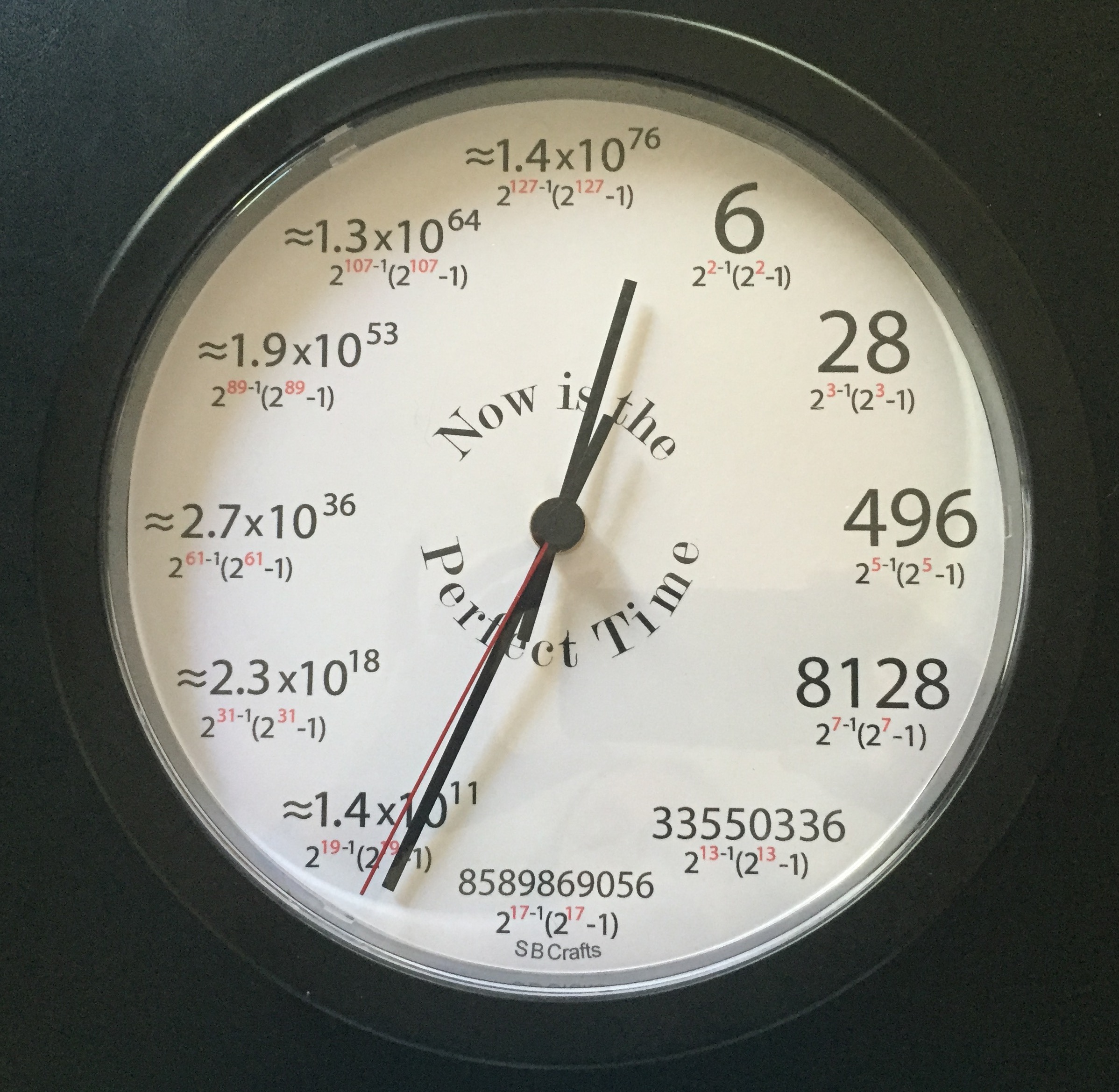
A natural number is called deficient, abundant, or perfect, depending on whether the sum of its proper factors is less than, greater than, or equal to the number itself. Most are deficient. Abundant ones, such as 12, 24 and 60, are used for measuring time, so we can divide it up lots of different ways. Scarcely any are perfect. The first four were known in 300 BCE, but the 49th, which
is ≈ 45 million digits long, was discovered in January 2016, the month this clock was created. It shows the first 12 perfect numbers, in terms of the corresponding Mersenne primes, whose index is in red. No one knows how many perfect numbers there are.
|
Another perfect clock for number theorists
or general number aficionados. |
| |
|
| |
|
The Math Clock
–
Pi Edition |
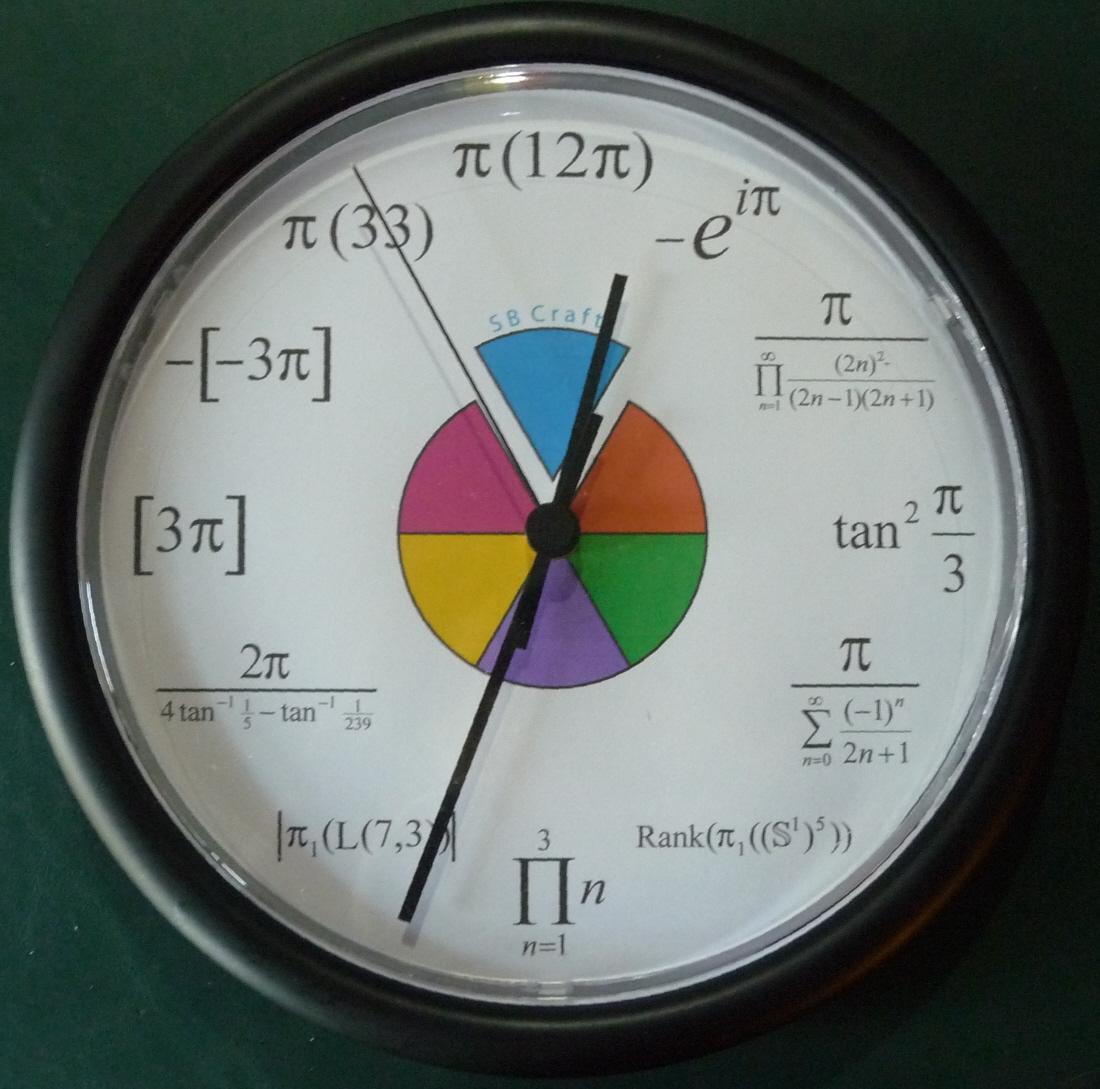
This clock was created especially
for Pi Day but it works just as well the rest of the year. The expressions
involve many different uses of π
as a mathematical symbol, not just for the well-known transcendental
number but for more obscure ideas in branches of mathematics from number
theory to algebraic topology.
(Thus, this
is a perfect horizon-expanding gift for those geeks who have been wasting
their extra brain cells competing to memorize the longest sequence of
digits constituting 0% of π's
decimal expansion!)
The colorful design in the center is, of course, a pie chart.
|
Our most advanced clock, especially
appealing to π
aficionados. |
| |
|
| |
|
The Math Clock
–
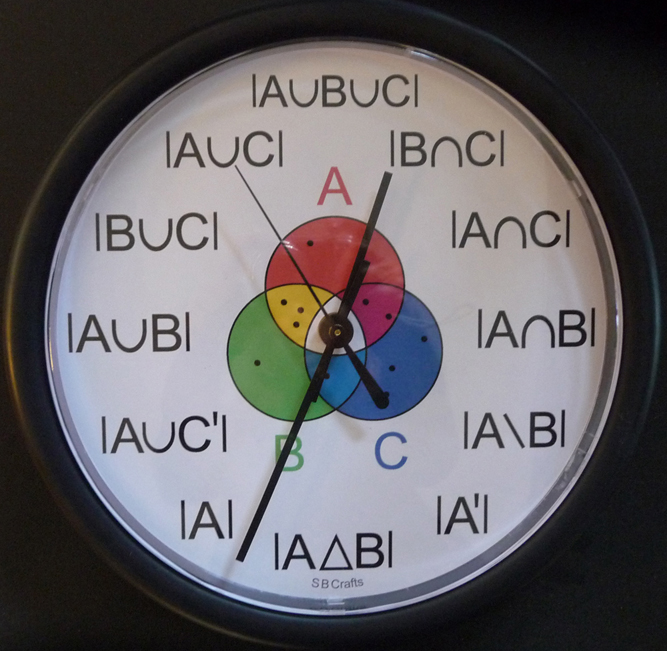
Sets Edition |
The colorful design in the
center of this clock is a Venn diagram that makes use of the additive colors of computer graphics. Thus the main sets are the primary RGB
colors, their binary intersections are the corresponding secondary CMY
colors, and the intersection of all of them is white.
The 12 elements of
this universe are placed to simultaneously maximize aesthetics and pedagogy,
illustrating many different elementary set theory concepts (unions,
intersections, complements, set differences, symmetric differences,
combining set operations, and cardinality).
|
For set aficionados and mathematics
classrooms. |
| |
|
| |
|
The Math Clock
–
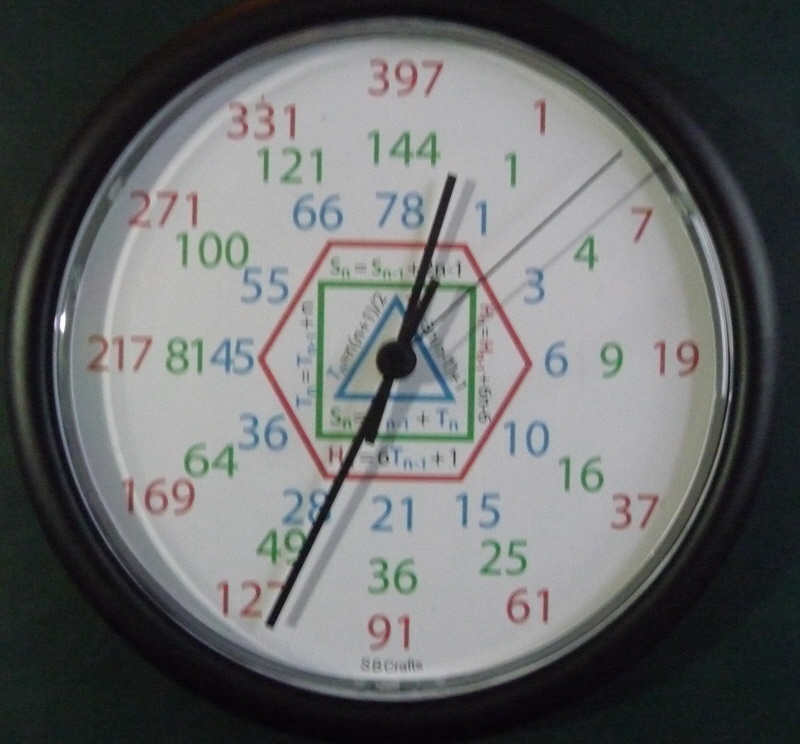
Figurate Edition |
The nth
hour is represented by the nth triangular number,
the nth square number and the nth
centered hexagonal number. To easily distinguish them, each type of
figurate number is colored to match the corresponding figure in the
center.
Also included in the central picture are recurrence relations, closed-form
expressions, and relationships between the three different sequences
|
Since this clock involves formulas,
it
is appropriate for
ages T4 to S10, like
the Fibonacci
Formula clock. |
| |
|
| |
|
The Math Clock
–
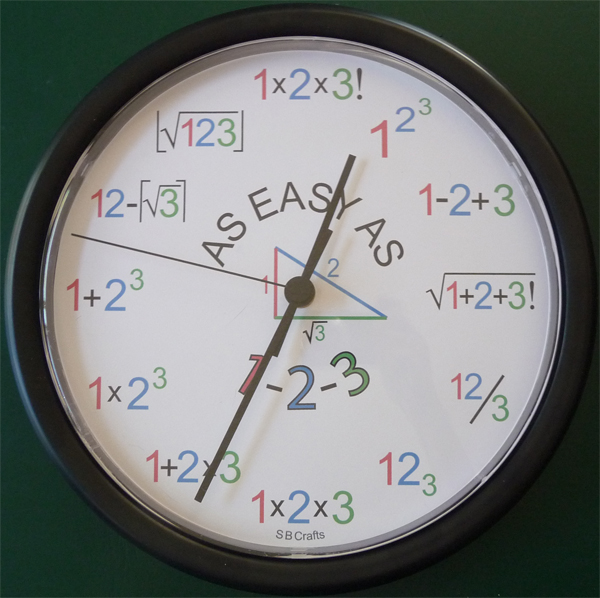
1-2-3 Edition |
In this clocks inspired by math circle students, the expression for each hour is composed of the numerals
1, 2 and 3, in that order. No other numbers, just operators and functions, are used.
The central picture shows a 30°-60°-90° triangle, because of its irrespective but mnemonic side length ratios of "one, two, root three".
|
Appropriate for ages
1x2x3 to123. |
| |
|
| |
|
The Math Clock
–
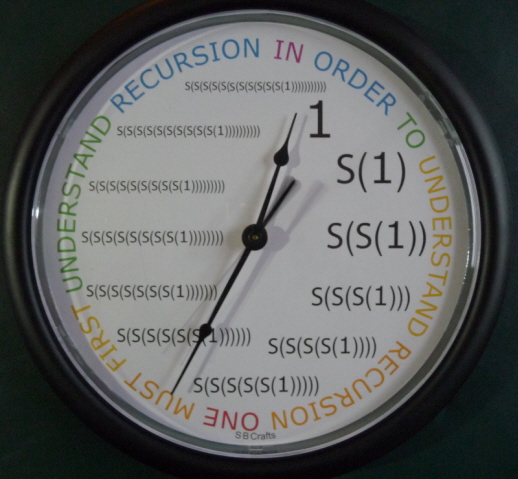
Recursive Edition |
Whether you start reading
the circular saying at the top or bottom of the clock, the circular
meaning is the same.
The text is colored in spectral order, somewhat like a double rainbow.
The successor function, an important primitive recursive function, is
applied to 1 n-1 times for the nth hour.
|
For fundamental number theorists,
theoretical computer scientists, and metamathematicians. |
| |
|
| |
|
The Math Clock
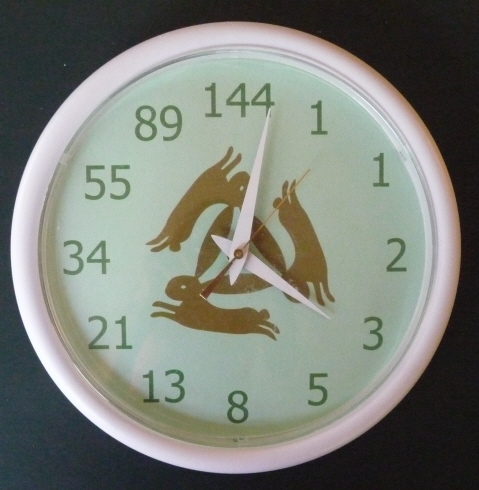
– Fibonacci Sequence |
In this clock, the hours
are represented by the corresponding number in the famous Fibonacci
sequence, which is 1,1,2,3,5,8,... The nth term
in the sequence, Fn, represents hour n
on the clock.
The rabbit motif highlights
the well-known origin of the Fibonacci sequence as a rabbit population
model. The design is based on an ancient puzzle called the three hares.
(It's a simple Sam Lloyd type puzzle: how many ears
are there if each of the 3 hares has 2 ears?)
The hour and minute hands are shaped like rabbit ears.
|
Appropriate for ages
8 to 89, especially
for Fibonacci aficionados. |
| |
|
| |
|
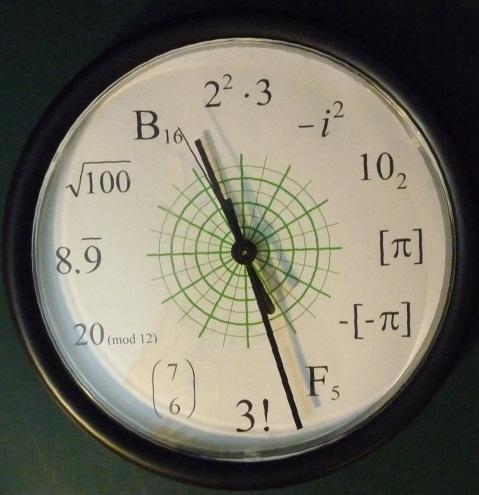
The Math Clock
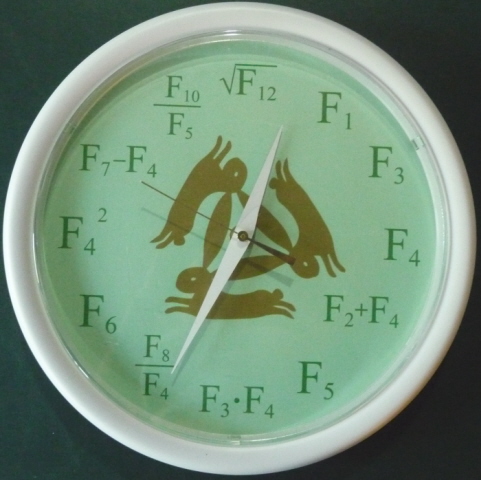
– Fibonacci Formula |
See the previous clock's
description regarding the design in the center and the clock hands.
In this variation, the hours are represented by arithmetic expressions
involving the terms of the Fibonacci sequence (i.e. F1=1,
F2=1, F3=2, F4=3, F5=5,
etc.) Students who are unfamiliar with the Fibonacci sequence
can actually derive it by using simple algebra to combine the expressions
and solve for the terms, and then deduce the pattern.
|
Appropriate for
ages 10 to 100. |
| |
|
| |
|
The Math Clock
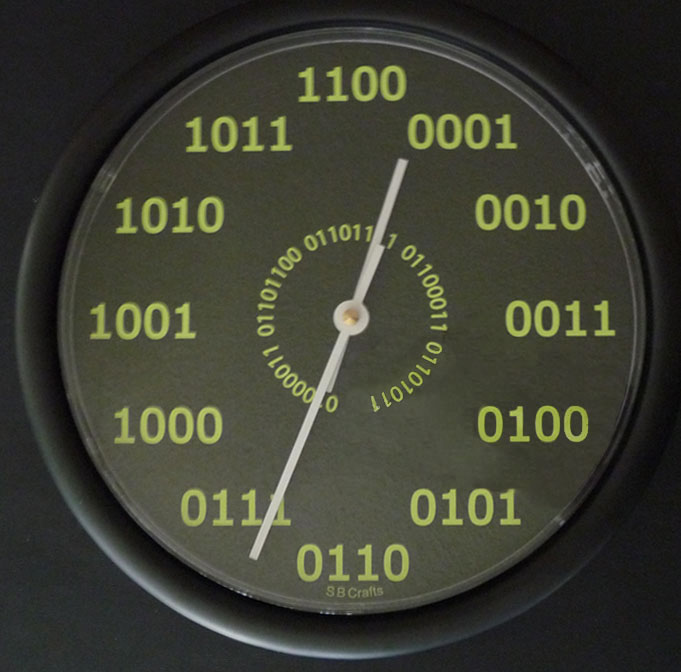
– Binary Edition |
This clock, a more colorful and more durable version of our binary CD clock, was created to coordinate with our binary wrapping paper. The numerals are a neon-like green, reminiscent of antediluvian computer screens, 'though not as bright as the paper or t-shirt. The text in the center is written in ASCII code and is as descriptive as that of the wrapping paper. Note that this clock does not have a second hand – after all, there are already too many digits in binary times!
|
For computer geeks
of
ages 10102
to 11001002. |
| |
|
The Math Clock
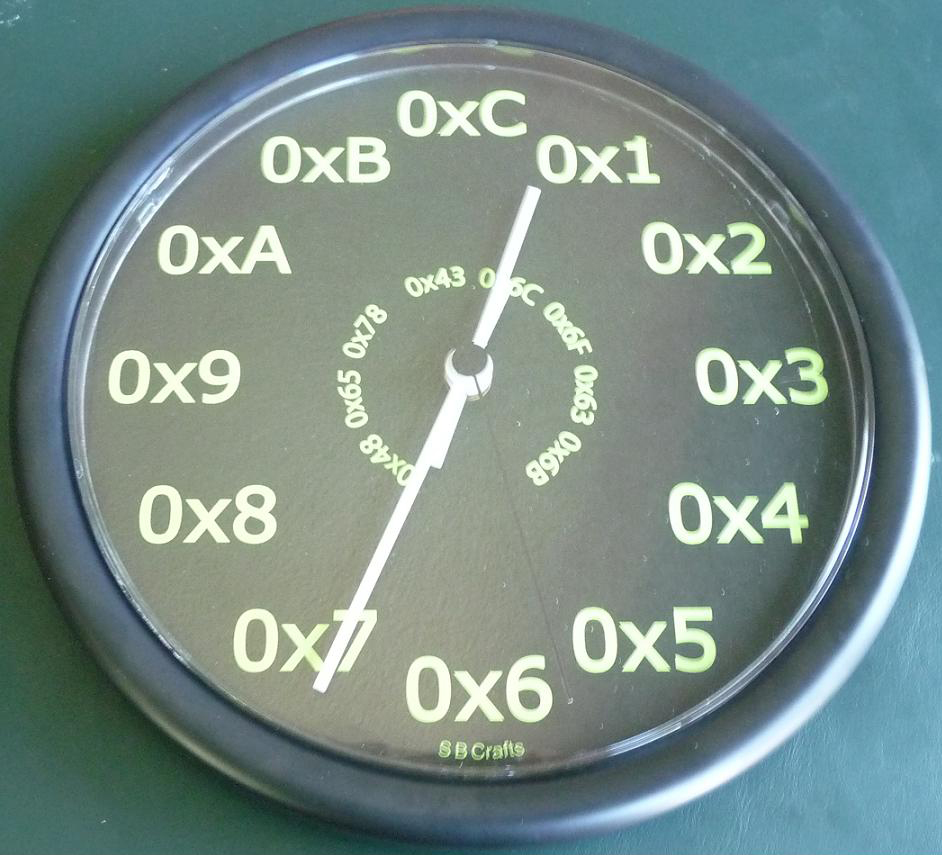
– Hex Edition |
This is the same as the previous clock (despite the poor photo quality) except that it uses base 16 instead of base 2, with a typical computer programming language notation for hexadecimal numbers, and it has a barely visible black second hand.
|
For computer geeks
of
ages 0xA
to 0x64. |
| |
|
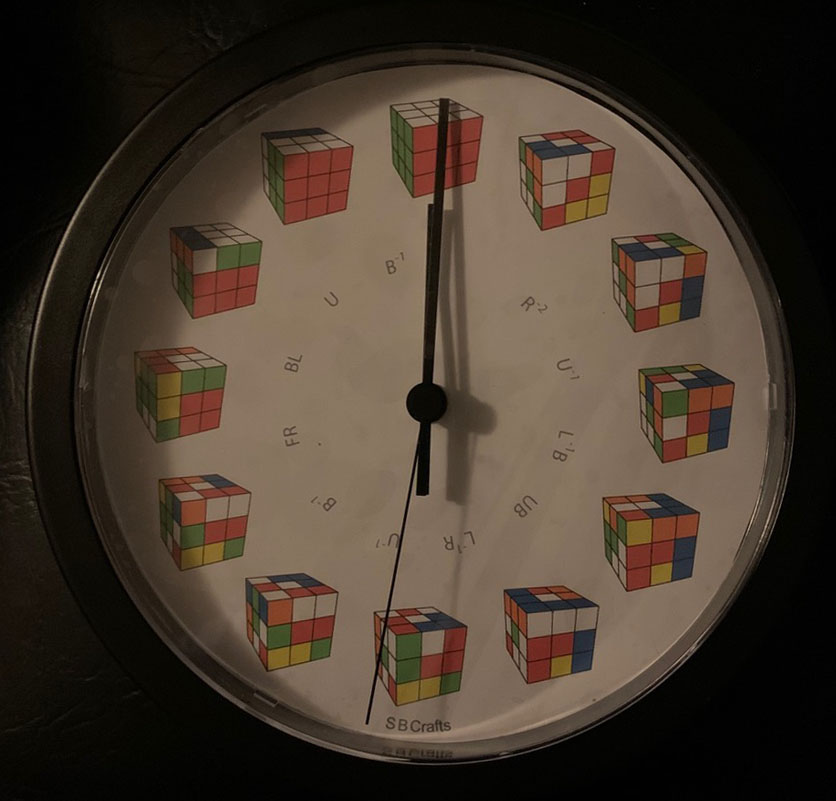
The Rubik's Clock - Solution Edition |
As the hours go from one to twelve, the cube gets solved in 11 stages, each of which involves just one or two turns. The steps' instructions are printed lightly on the clock face's inner circle in a standard code, which is explained in detail on the back of the clock. The images and instructions are from Tom Davis.
|
For Rubik's Cube aficionados who
care about time. |
| |
|
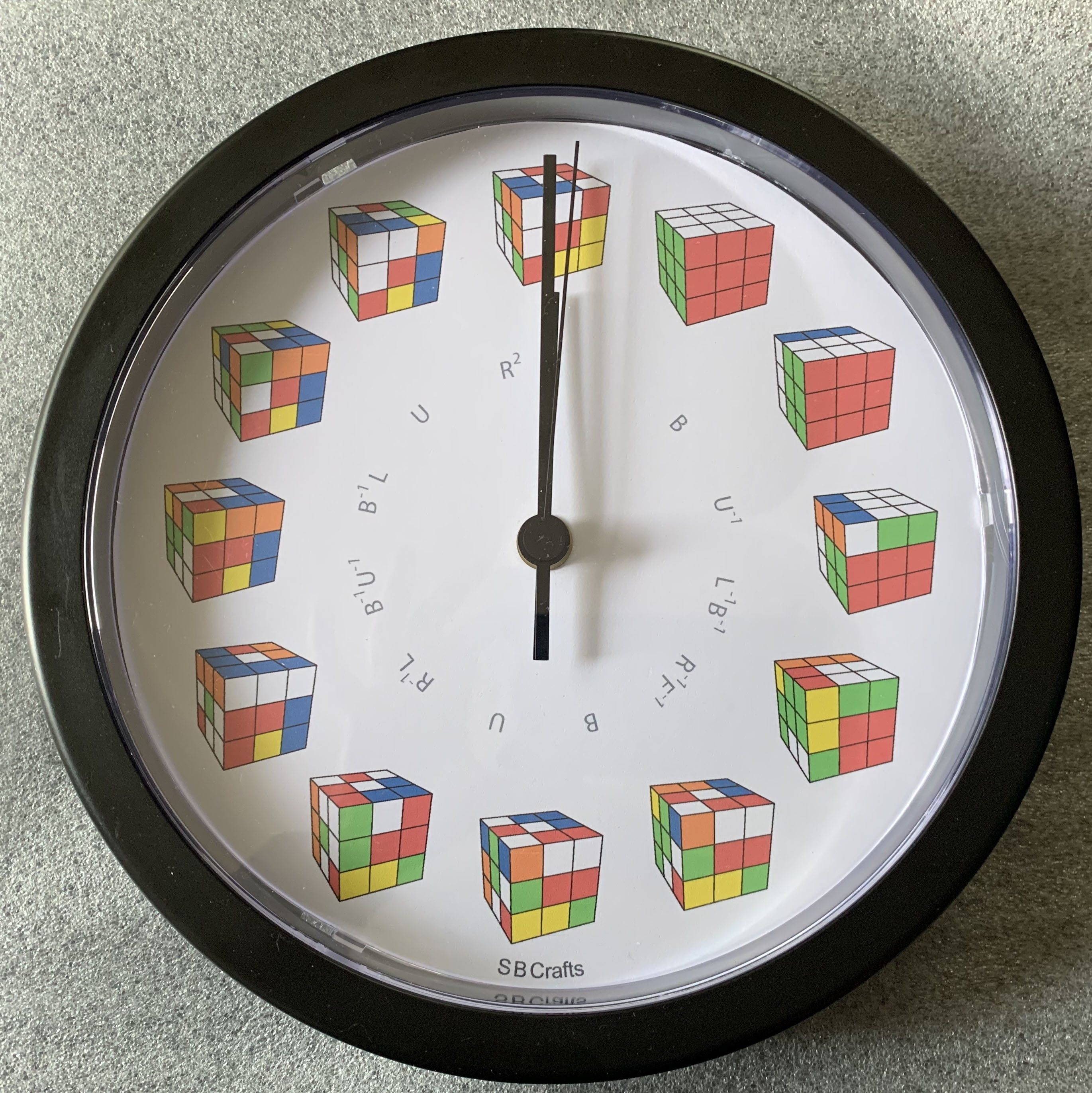
The Rubik's Clock
–
Design Edition |
This is the same as the previous clock except that it goes in the other direction - from a solved cube to the mountain "peak" design, with the accompanying instructions reversed, of course. Apparently some people who can solve the cube like to spend time creating designs rather than just speed up their solving time.
|
For artistic Rubik's
Cube aficionados. |
| |
|
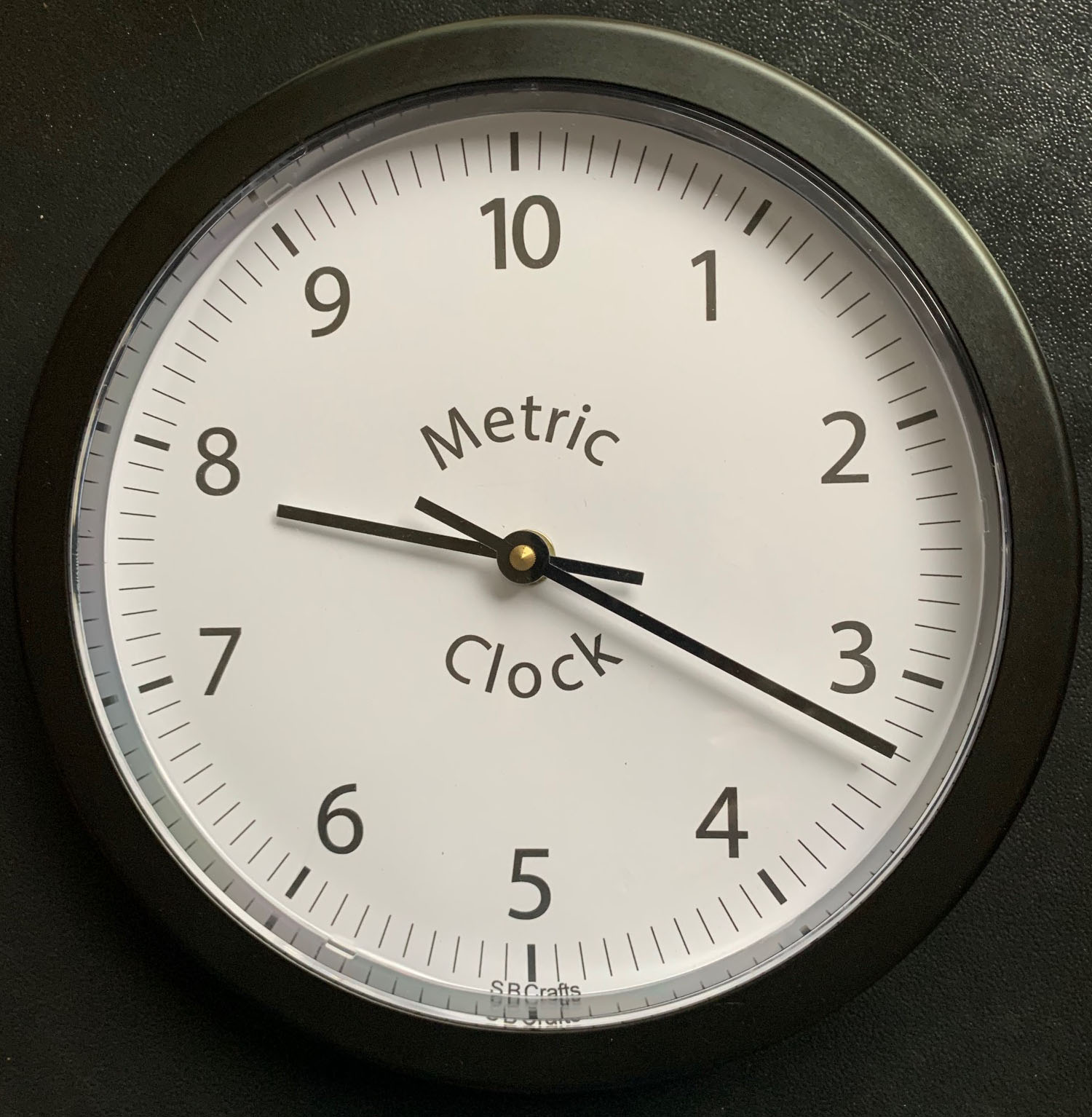
The Math Clock
– Metric Edition |
A great gift for people who are constantly trying to promote the metric system in the US. While we support their hopeless cause, at least for distance and mass, 12 and 60 are far better choices for dividing time into, because they are both abundant and superior highly composite numbers. Decidays are indicated with thick ticks marks, and centidays with thin tick marks, around the outer edge. Since the clock movement is not metric, on most decidays, the centiday hand will not be pointing straight up – 5 o'clock and 10 o'clock are beautiful exceptions. On the other hand, that means this clock is still useful for people old enough to tell time from the hands' angles.
No second hand is included, since it could be disconcerting to hear a tick every 23 microdays.
|
For metric
proponents of
ages 10 to 100. |
| |
_ _
_ _ _ This
is the dividing line between the math clocks and the non-math clocks,
_ _ _ _ _
although we admit that there's some mathematical
flavor in virtually all of our clocks.
|
| |
|
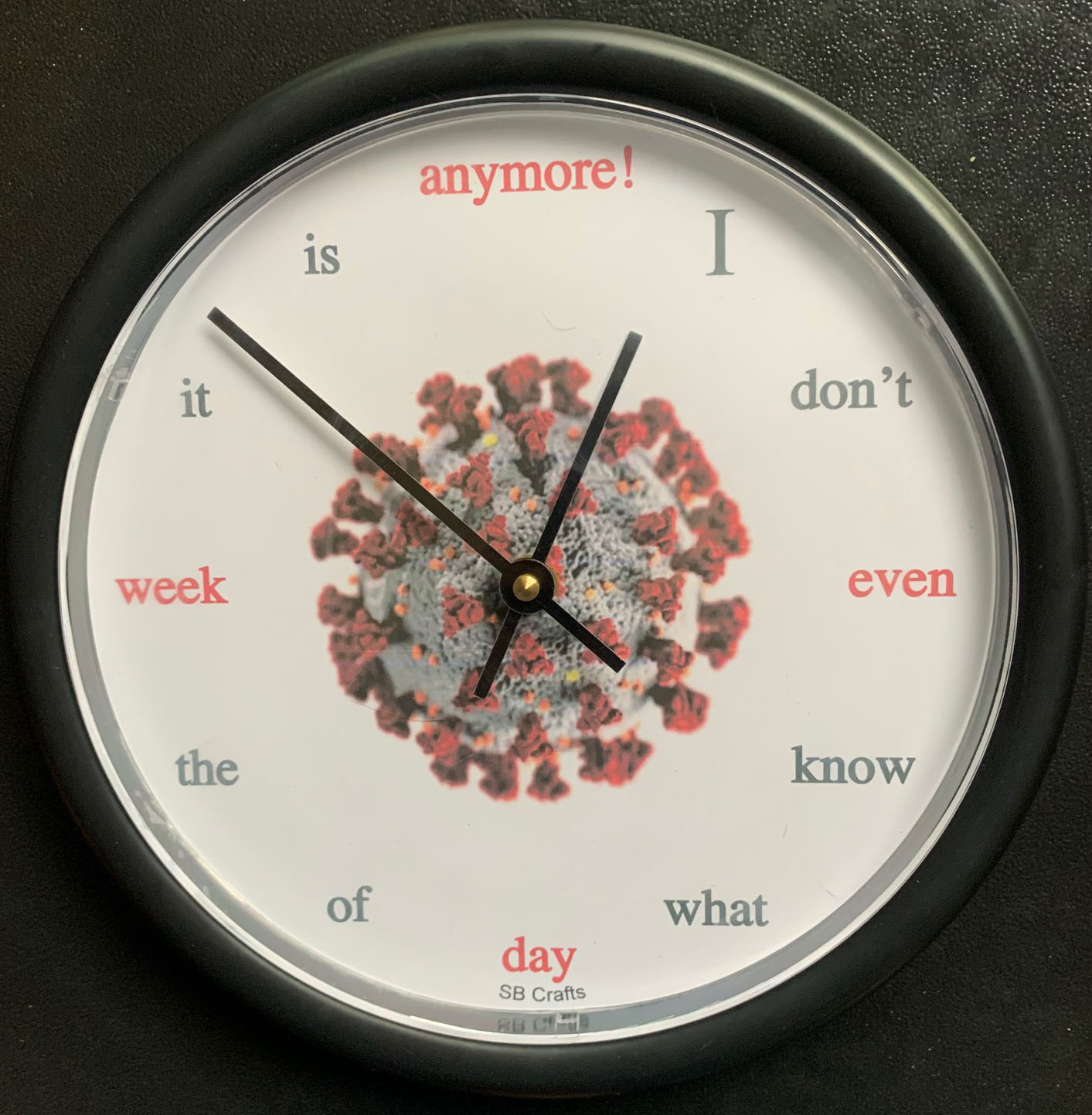
Corona Time
–
The Covid Clock |
The Roman numeral I at the 1 o'clock position is actually the letter I, beginning a 12-word sentence that expresses why you don't need this great time conversation piece.
Note that these clocks don't actually tell time - they may be fast, slow, floppy or stagnant. Thus we are selling them at cost, i.e. 50% off, during the pandemic. Any amount you choose to pay above cost will be donated to a local Covid relief fund. A working version may be available upon request. There's no second hand since we think silence is more important than the semblance of precision these days.
|
For anyone who doesn't have an "essential" job. |
| |
|
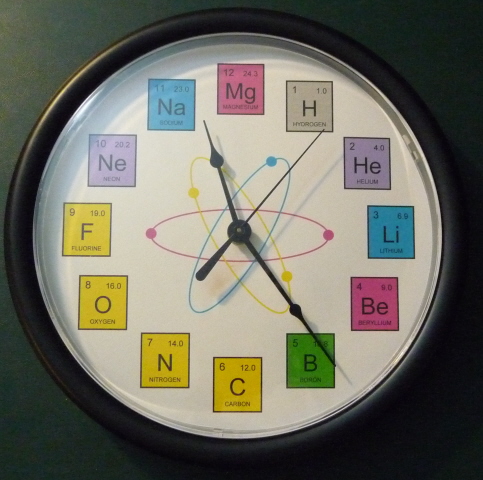
The Chemistry
Clock |
The hours are represented
by the atomic numbers of elements, namely the first 12 elements of the
periodic table. Different background colors correspond to different
kinds of elements, such as alkali metals and noble gases. A colorful
key on the back of the clock explains the types of elements as well
as all the other symbols from the periodic table.
The canonical image
of electron rings in the center matches the hours chromatically and
the clock hands thematically.
|
Appropriate for ages 10 to 100,
and
science classrooms. |
| |
|
| |
|
The
Hebrew Clock |
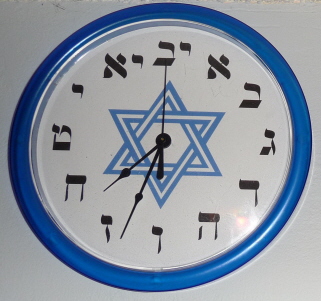
In Hebrew, the letters of
the alphabet have numerical values, which are used to represent the
hours on this clock (e.g. alef is 1, yud is 10, yud-alef is
11). The ornate style of the hands matches the calligraphic font.
|
Appropriate for ages
5 to 500,
and Hebrew school classrooms. |
| |
| |
|
The
Hebrew Clock – Reverse Version |
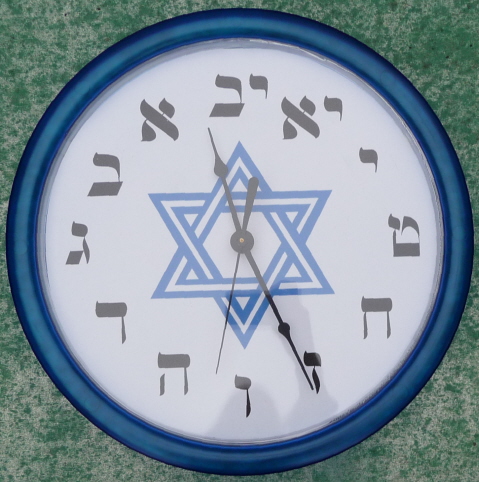
Since Hebrew is read from
right to left, just for fun this clock runs backwards! It looks particularly
nice when placed side-by-side with the previous one, as they're then
mirror images. Sorry, this clock is currently unavailable. Email to be notified when it becomes available.
|
Appropriate for ages 500 to
5. |
| |
| |
|
The
Hindi Clock |
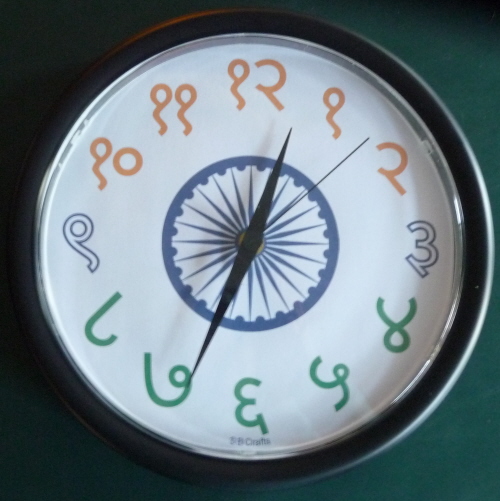
Contrary to popular belief
in the West, the Arabs were not the first to use a positional decimal
numeral system – they learned it from the Indians (who
may have learned it from the Chinese). The numerals on this clock
are the Indian ones in their modern Devanagari form.
The clock's coloration and central design reflect those of the flag
of India. In fact, the 24 spokes of the Ashoka Chakra represent
the 24 hours of the day.
|
For aficionados of India and/or
history of science. |
| |
|
| |
|
| |
|
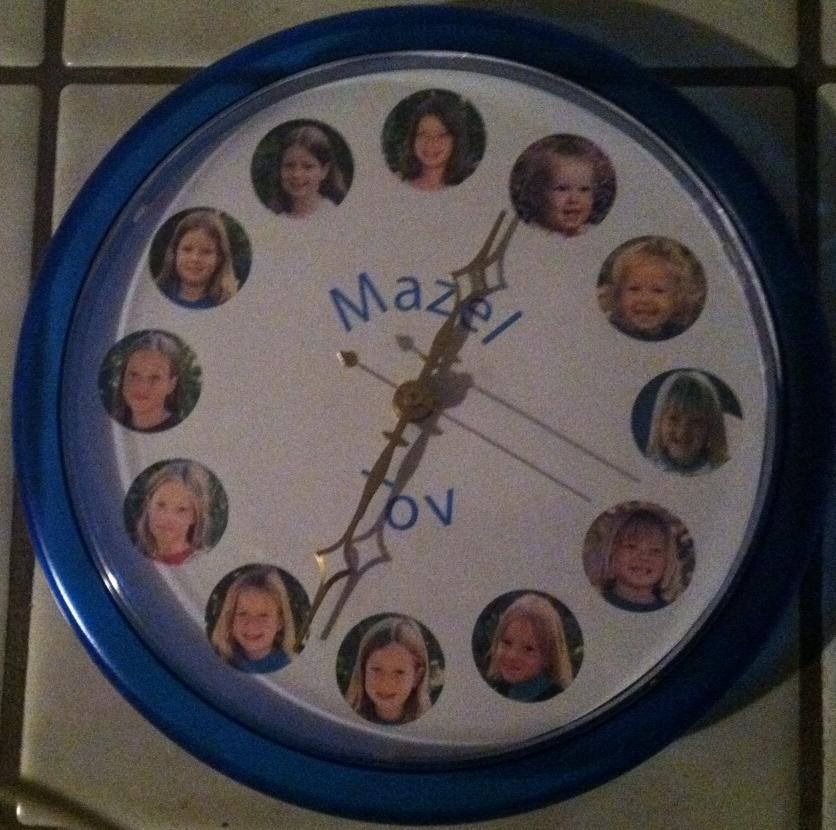
The
Portraits Clock |
Our most personalized clock is appropriate as a Bat Mitzvah gift with portraits from the ages 1-12, or a first birthday gift with monthly photos, or a high school graduation gift with portraits from the grades 1-12, or a Mother's Day gift for a woman with 12 grandchildren, or . . . The gold-hued hands feature diamonds and a heart, connoting preciousness and love. Both the wording and the rim color are somewhat customizable.
|
For special people
on special occasions. |
| |
|
|
General description:
All models come in a 10"(25cm)-diameter size, suitable for homes and offices.
The black-rimmed ones are also available in a 14"(35cm)-diameter size – which is
almost twice as large! – suitable for classrooms and studios.
Each clock has metal hands, not plastic, and a U.S.-made I-shaft movement (except for
the reverse movements, which are from Asia); and requires one AA battery, not included.
Prices: All 10" clocks cost $40 except for the following:
- the prime and primorial
versions, which are priced at P13
($41) and P14
($43), respectively
- the Fibonacci versions, which cost F9
($34)
- the pi clock, which is
priced at ≈ 14 π dollars ($44)
- the 1-2-3 version,
which costs $12x3 ($36)
- the binary clock, which costs $1010102 ($42),
and the hex clock, which is only $2916 ($41)
- the Hebrew clock, which is priced at double-chai ($36)
- the ones that run backwards,
which cost $120
- the personalized business ones,
which cost $75 (but are probably tax-deductible)
- the JRMF ones,
which cost $50 (and are partly tax-deductible)
- the portraits clock, which is priceless (but please inquire anyway!)
The 14" clocks cost an additional $20.
California residents must add sales tax.
Shipping Click here for new, fairer shipping cost tables
Please note that deliveries outside the U.S. may be subject to customs duties, taxes
and/or fees upon arrival; these costs are not included in our product or shipping charges.
Buying a Gift? Mathematical wrapping paper is
$4.
Can't Decide Which
Clock to Buy? Cute gift certificates are also available.
(Even by email for last-minute gifts.) |
| |
|
To order by check, send to SB Crafts at 6167 La Goleta Road, Santa
Barbara, CA 93117.
Be sure to include an email address and/or phone number in case we need to contact you
If you have a PayPal account, you can send the payment to paypal@sbcrafts.net (note: not .com).
|
| |
For any questions, PayPal assistance, international, wholesale
or rush orders,
email
info@SBCrafts.net
or text (805) 680-9950.
|